3.6K
Kirkuk
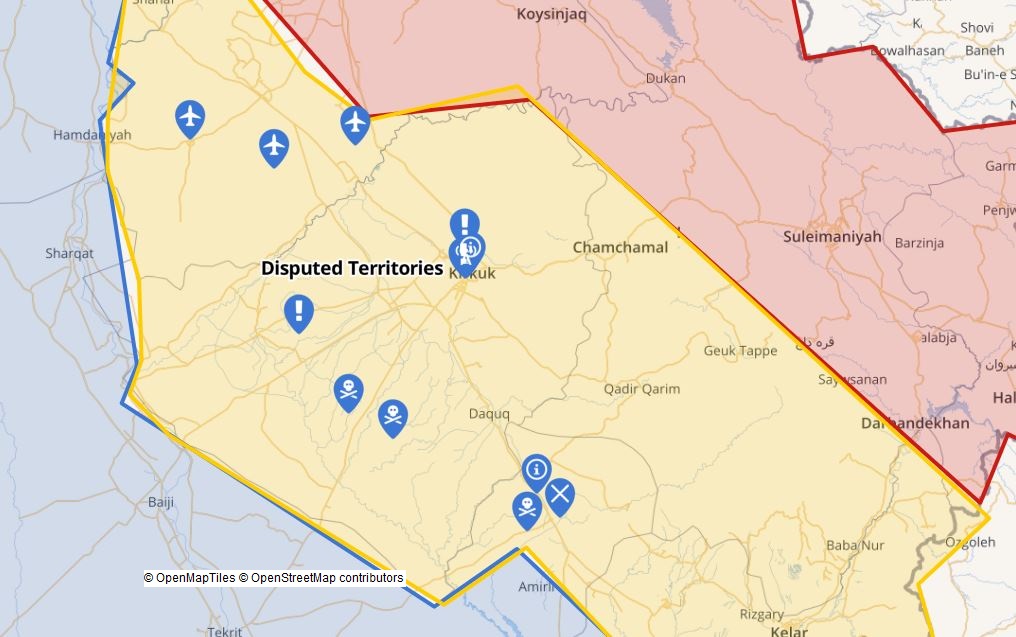
- ISIS (Da’esh) continued attacks in Kirkuk suburbs and across the disputed territories. On Friday, September 3rd, Da’esh terrorists attacked a federal police checkpoint, killing an officer and wounding two more in Daquq’s Sobghan village. Furthermore, on late Saturday night, Da’esh terrorists launched a major attack on the federal police near Rashad sub-district, killing 13 officers by snipers, light guns, and an IED, which hit a backup convoy during the clashes. The Iraqi Prime Minister Mustafa al Khadimi chaired an “urgent” meeting of the National Security Council. Following this meeting, the Minister of Defense, Juma Inad, visited Kirkuk to launch investigations into increased Da’esh attacks. Inad told reporters that 85% of the attacks were due to “negligence” by military personnel. Meanwhile, with US-led Coalition air support, Iraq’s Counterterrorism Units ambushed a Da’esh scout near Perdi (Alton Kopry) on Tuesday, killing several. US jets targeted the hideouts of those who fled the Iraqi ambush. Moreover, Iraqi warplanes stuck north of the Sargaran sub-district. In the recent week, Da’esh terrorists have been clashing directly with security forces as opposed to their use of IED attacks in the past, a sign of their strong reemergence in the area. After years of assuming responsibility in Kirkuk, the Federal Police will be replaced by Iraq’s 8th army division. At the same time, the Iranian-backed militias sent three more brigades to Kirkuk with heavy weapons. Since October 16, 2017, the Iraqi forces have struggled to fill the security vacuum left by removing the Peshmerga forces from the region.
- Kirkuk’s police announced the seizure of an office used in the city for illegal trade of natural resources, including oil and gas. According to a statement, the office was shut down, three suspects were taken into custody, and two tankers were confiscated. Kirkuk faces a severe gas shortage, mainly due to smuggling linked to militias and political parties.
- After four years of absence, the Kurdistan Democratic Party (KDP) returned to Kirkuk and launched its parliamentary election campaign. According to the KDP candidate Shakhwan Abdullah, the party will reopen its headquarters next week. The Iraqi security forces occupied KDP’s main branch in Kirkuk on October 16, 2017. Following which, the KDP boycotted the 2018 elections.
- The Turkish-backed Turkmen Front and the Arab Coalition held a press conference against the planned return of the Peshmerga forces to the province. Officials from both sides denounced any forms of security cooperation between the Kurdish Peshmerga and Iraq’s federal forces. Recently, Baghdad and Erbil agreed to create joint Peshmerga and Iraqi military brigades and deploy them in the disputed territories where the terror group has been actively launching attacks.
- According to the Kirkuk office of the Iraqi High Commission for Human Rights, suicide rates have increased in the province in the first half of the year, reaching 50, including 41 females and 11 males. The commission also reported 260 cases of domestic violence.
Khanaqin
- On Tuesday, September 7th, Da’esh terrorists attacked an army checkpoint in the Halwan area between Khanaqin and Jalawla (Golala). After nearly an hour of clashes and an IED explosion, which hit the support team, two soldiers were killed, and four more were injured, including a commander.
- In an interview with al Iraqia channel, the Oil Minister, Ihsan Abdul Jabbar said that several French companies have expressed interest in oil investments in Khanaqin. He offered no further elaboration.
Tuz Khurmatu
- A Da’esh sniper near Yangeja, west of Tuz Khurmatu, killed one and wounded two members of the Iran-backed militias on Saturday, September 4th. On Tuesday, September 7th, Da’esh slogans and warnings to security forces and citizens were found written on 13 walls across the town, a move that shocked the security forces.
- Several public figures and community leaders are trying to convince the Kurdish parties to unite under one candidate in Tuz Khurmatu. This is to prevent a scattering of Kurdish votes across multiple candidates, which could cost the parties a parliamentary seat. Since 2003, without a cohesive backing of one candidate, the Kurds in the town have not been able to win a seat in parliament and fear the new election laws will make it harder to win with multiple candidates.
Makhmour
- On Friday, September 6, a Turkish drone strike on the Makhmour refugee camp caused material damage. The airstrike hit a playground in the early hours that caused additional damage to nearby homes. The security forces in Makhmour continue to restrict large crowds in the town fearing more casualties due to Turkish airstrikes.
Shingal (Sinjar)
- After two airstrikes on the Yazidi town last week, the Turkish Defense Ministry proclaimed “success” without publishing further operation details. Meanwhile, Pro-PKK Yazidi media outlets accused Turkey of aiding Da’esh by attacking the Sinjar Resistance Units (YPS) and allowing terrorists to take over the Shingal heights. Furthermore, as the town suffers from lack of services and security, a delegation of senior Yazidis is set to visit Baghdad and raise the issue with the federal government.