
By Chris Law MP and David L. Phillips | March 29, 2026
What’s next for Iran? Iranian Kurds envision a political transition to federalism when the war is over.
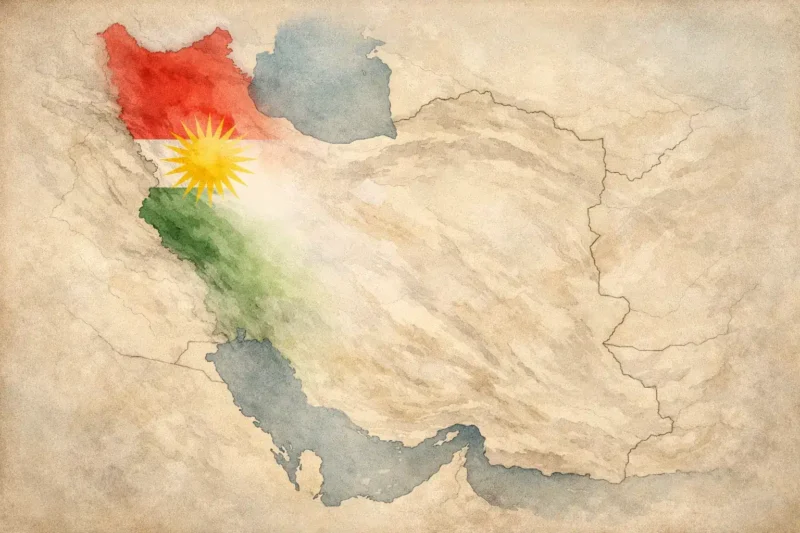
Kurds in Iran number about 12 million, living in remote regions of Iranian Kurdistan bordering Iraq and Turkey (Rojhelati Kurdistan). Kurds and other minorities prefer a decentralized federal system of government that provides local control over economy, government and culture.
Iranian Kurds have recently met to consider federal power sharing as an antidote to Tehran’s tyranny. Iranian Kurds from the Kurdistan Democratic Party of Iran, Komala, and other Kurdish parties view federalism as an effective way to promote minority rights. About half of Iran’s population is made up of minority groups, including Azeris, Kurds, and Baloch. Adopting a federal constitution would be a form of regime change that advances democracy and conflict resolution.
Changing Iran’s constitutional structure requires legal reform, which can occur when the clerics relinquish their grip on power. Constitutions provide a basis for the rule of law, distributing governance responsibilities and defining the relationship of individuals and groups to one another and the state. Constitutional power sharing addresses expectations in countries undergoing political transition. Such reform is most essential in societies with ethnic and sectarian divisions, or countries emerging from ethnic or religious conflict.
Reform in Iran will require both vertical and horizontal arrangements. The vertical separation of powers involves national-subnational arrangements, as defined through confederation, federation, asymmetric power-sharing or provisions for regional or cultural autonomy. Horizontal separation of powers can be achieved by redefining the relationship between the executive, legislative and judicial branches of government. The two overriding issues under international law are equality/non-discrimination and the protection and promotion of the unique identity of minorities. Iran is a majority Muslim country, with an overwhelming Shia population, as well as some Sunnis and Christians.
Federalism can provide cultural autonomy and minority rights. Varying degrees of autonomy are typically allocated to cultural expression in the areas of language, education, religious matters, and symbols of cultural identity. Equal access to education and language rights is critical to cultural identity. Minority groups should have the right to their own flag, anthem and other symbols of cultural identity.
They should have effective participation in economic development. This includes land and natural resources, as well as exploitation of oil, gas and minerals, as well as forestry and water resources. Minority groups should have control over taxes and revenue and trade. The administration of justice could also involve the devolution of police and security in the regions with security reflecting the population of ethnic and religious communities where they serve.
Iranian Kurds have been meeting to discuss Iran’s future governance arrangements. They have endorsed decentralization and federalism as a useful strategy for resolving differences including center periphery relations. Federalism is a proven strategy for resolving conflict. Kurds look to international models for guidance on Iran’s transition. The experience of Quebec Greenland and South Tyrol is instructive.
Quebec is a province of Canada with a culture rooted in French language and tradition. About a quarter of Canadians are French speaking. Two referenda were held on Quebec’s political status in 1980 and 1995. Neither received enough votes to trigger secession from Canada. But the mere consultation was an exercise in democracy.
Greenland is a self-governing overseas administrative division of Denmark. About 87 percent of the population is Greenlandic with the other 13 percent Danish or other types of Scandinavian descent. Greenland has been under Danish control since 1380. Its current self-governing status was established in 1979 with passage of the Greenland Home Rule Act, which anchors Greenland in Denmark, a country of the European Union.
In Italy’s South Tyrol province, 64 percent is German speaking and 30 percent speak Italian. Austria and Italy signed the De Gasperi-Gruber accord in 1946 guaranteeing rights for the German speaking populations, including equal status of German and Italian, elementary school teaching in German, the use of German and Italian for official purposes, and equal opportunity for German speakers in public office. The 1972 Autonomy statute gives South Tyrol control of local economy, public works, education, public welfare, local communications and transport.
Another example, however imperfect, is the Iraqi constitution of 2003. It provides for power-sharing, but commitments such as a referendum on the status of Kirkuk were never adopted.
Some view federalism in Iran as a step towards fragmentation. That may be the outcome if the parties agree to friendly divorce. Alternatively, power-sharing can help strengthen national unity and common purpose. Federalism can be an effective system for resolving differences and competing claims.
Iran is at a fork in the road. The Iranian people demand change. When the clerics loosen their grip, Iranians will be able to make choices about their future government.
Christopher Law is a Scottish National Party politician serving as the Member of Parliament since 2015 from Dundee Central, Scotland.
David L. Phillips is a former US and UN official who is presently an Academic Visitor at Oxford University St. Antony’s College.
Disclaimer: The views expressed here represent those of the author and not necessarily those of the WKI.