
By: Dilan Karim | August 14, 2026
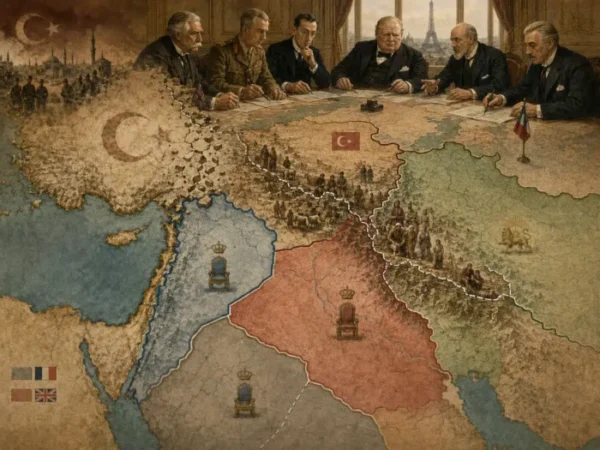
The end of the First World War left the vast territories of the Ottoman Empire without a governing authority. This created a power vacuum that European powers answered with imperial self-interest rather than justice. When the statesmen representing the Allied powers assembled at the Paris Peace Conference in 1919, the fate of millions across Europe and what is now the modern Middle East was decided in conference rooms by leaders whose decisions reflected limited understanding of the region and placed little weight on its political aspirations as well as its cultural and religious realities. The resulting arrangements—a web of mandates, redrawn borders, and installed monarchies—would define the region for generations. The Kurds were among those most adversely affected by the decisions made at the Paris Peace Conference. Despite initial postwar provisions that would grant the Kurds full autonomy, they emerged without a state. The decisions and treaties of the Paris Peace Conference were fundamentally responsible for instability in the Middle East, as the peacemakers drew borders with no regard for their respective populations, installed puppet monarchies, and fragmented forty million Kurdish people across four countries.
By the end of World War I, the Ottoman Empire had collapsed, leaving an ungoverned, ethnically diverse territory that the European powers sought to control and redraw to serve their own interests. For decades, the Ottoman Empire had been labeled as the “Sick Man of Europe,” struggling with internal corruption, weakened central authority, and the belief among European nations that it was unfit to self-govern.[1] George Curzon, the acting foreign secretary of Great Britain at the time of the conference, even went so far as to describe the Ottoman Empire as “this canker which has poisoned the life of Europe.”[2] This perception would later be used to justify the mandate system, in which European powers assumed control under the pretense of guiding these territories toward eventual independence. The Armistice of Mudros, signed in October of 1918, marked the end of the Ottoman Empire, dissolving Ottoman military resistance, opening its major straits to Allied occupation, and ending its political authority throughout the Arab world.[3] What made these decisions so consequential was the large diversity of the populations living within the former Ottoman borders. For centuries, Kurds, Arabs, Jews, Turks, and Armenians coexisted uneasily under a single imperial rule as ethnic and religious divisions remained unsolved. Arab nationalist movements had also been gaining momentum during World War I, and Britain had promised Arab leaders independence in exchange for their military support in revolting against the Ottomans. These promises would later be directly contradicted by the mandate systems that emerged from the Paris Peace Conference.
The Paris Peace Conference was shaped by the competing imperial ambitions of Britain and France. Operating largely without indigenous representation, they used the conference to distribute former Ottoman territories in ways that served European strategic and economic interests at the direct expense of the region’s inhabitants. The conference was dominated by “The Big Four,” composed of Woodrow Wilson, David Lloyd George, Georges Clemenceau, and Vittorio Orlando. Its decisions about the Middle East were made with minimal input from the Arab, Kurdish, or other populations whose lands were at stake. Additionally, World War I veteran A.E. Montgomery emphasized that “Lloyd George had dominated the conference, taking full advantage of his position as chairman to outmaneuver his allies and, at times, his foreign secretary as well.”[4] Lloyd George sought not only to advance British interests at the expense of the populations of former Ottoman territories but also to exploit fellow Allied representatives in shaping postwar settlements. Moreover, Woodrow Wilson, the American president, had publicly emphasized the importance of self-determination for the populations living under Ottoman rule, but his vision was never meaningfully applied to the Middle East. The mandate system that Britain and France implemented at Paris directly contradicted this ideal, as it substituted European imperial interest over the self-governance Wilson advocated for.[5]
The peacemakers imposed arbitrary borders on the Middle East through the mandate system established in Article 22 of the Covenant of the League of Nations, creating artificial states that ignored ethnic and religious realities, leading to long-lasting regional conflicts. Article 22 designated former Ottoman territories as “Class A” mandates, which were territories theoretically being guided toward independence but were actually placed under strict European control.[6] The language of Article 22 spoke of tutelage, the “well-being and development” of subject peoples, but the actual conduct of the mandatory powers revealed these phrases to be a cover for colonial administration.[7] Under the settlement, Britain received control of Iraq, Palestine, and Transjordan, while France was assigned Syria and Lebanon. The borders that demarcated these new states were drawn with straight lines and geographic features that had no correlation to the ethnic or sectarian distributions of the people living there.[8] Margaret MacMillan highlights that “In 1919, there was no Iraqi people; history, religion, geography pulled the people apart,” meaning that forcing all these ethnic groups into one area was bound to be problematic.[9] Unified communities, particularly the Kurds, were split across multiple new states, while historically rivaling groups were forced into single political entities. Iraq, for example, was formed by combining Sunni and Shia Arabs with the Kurds into a single state, despite the absence of a shared national identity and the presence of deep internal divisions.[10] Syria and Lebanon were separated by France specifically to weaken the Arab nationalist movement. Additionally, France handed over part of their mandated territory in Syria, the Sanjak of Alexandretta, to Turkey, a decision that directly violated France’s obligations as a mandatory power.[11] Mandatory Palestine placed the British in the impossible position of administering the nationalist aspirations of both Jewish and Arab populations, each of whom believed they held legitimate claims to the land. The immediate consequence of these arrangements was widespread instability across the Middle East. Arab uprisings started across Iraq and Syria in the 1920s, Kurdish revolts challenged Turkish and British authority, and Jewish resistance to the British mandate intensified. The French also heavily bombarded Damascus in 1925 as a result of the Great Syrian Revolt, illustrating the profound failure of the mandate system to establish legitimate governance.[12]
To consolidate European control over the Middle East, Britain and France installed puppet monarchies in the newly created states, imposing rulers that lacked legitimacy among local populations and required continuous imperial support to maintain power. The most prominent example was Faisal ibn Hussein, who was installed as King of Iraq by the British after having been expelled from Syria by France.[13] Faisal had been born in Mecca and had no prior connection to the Iraqi people or territory. His installation served British strategic interests rather than any meaningful expression of Iraqi popular will. To provide a facade of legitimacy, a “plebiscite” was held, a process that was essentially controlled and manipulated by the British authorities to produce a predetermined outcome.[14] Similarly, Abdullah ibn Hussein was placed in charge of Transjordan, again to serve British imperial interests in the region. The nature of these puppet monarchies was defined by their total dependence on British military and financial support for their survival. Britain continued to exercise actual authority over foreign affairs, natural resources, and military affairs through the structure of the mandate system.[15] Additionally, local populations derived almost no benefit from Iraqi oil wealth. Through the Iraq Petroleum Company’s concession arrangement, Britain was given control over Iraqi oil for 75 years.[16] The instability produced by these imposed authorities was immediate and severe. Throughout the 1920s and 1930s, the Middle East was impacted by coups, revolts, and political violence due to ruling structures that lacked the legitimacy necessary to govern effectively. As a result of this turmoil, the British in Iraq bombed tribal villages to enforce obedience to the unrepresentative government they had created, exposing the profound contradiction between the mandate system’s stated ideals and its brutal practice.[17]
The Treaty of Sèvres briefly offered Kurds the right to independence, marking the first international recognition of Kurdish autonomy, a promise that proved to be fruitless by shifting geopolitical circumstances. Articles 62 through 64 of the Treaty of Sèvres, signed in August of 1920, called for full autonomy in the predominantly Kurdish areas of the former Ottoman Empire.[18] Article 64 went further, emphasizing that if the Kurdish population demonstrated that independence was desired, the League of Nations would grant them statehood.[19] As MacMillan describes the situation, “Kurdistan had even less chance than Armenia of finding a protector,” but Sèvres at least put Kurdish rights on paper.[20] These provisions, however, were fragile from the outset. The promise of Kurdish autonomy was predicated on a weakened Ottoman state that would accept Allied terms at Paris, but MacMillan emphasizes that “unlike other emerging nations, Kurdistan had no powerful patrons in Paris, and the Kurds were not yet able to speak effectively for themselves.”[21] The British were also never fully committed. Their interest in Kurdish autonomy was mainly strategic. Rather than a principled commitment to Kurdish self-determination, Britain envisioned a buffer zone protecting their Mesopotamian mandate from Turkish and Soviet influence.[22] Throughout 1919, British officials simultaneously encouraged Kurdish independence movements while quietly telling other parties that these promises meant nothing.[23] The Treaty of Sèvres was never ratified by the newly established Turkish government under Mustafa Kemal Atatürk, who viewed its terms as a direct threat to Turkish sovereignty and national identity.
Led by Atatürk, The Turkish War of Independence, which resulted in the Treaty of Lausanne, completely nullified the Kurdish promises established in the Treaty of Sèvres. The Allied powers capitulated to Turkey’s demands and abandoned the Kurds in order to maintain stability with the Turks. Atatürk’s military campaigns in Anatolia proved to be devastatingly effective, and the Allied powers, exhausted from World War I and unwilling to commit forces to another conflict, agreed to negotiate a new settlement entirely.[24] The Treaty of Lausanne ultimately became the framework that settled the post-war status of the former Ottoman territories. As Edgar Turlington highlights, the settlement at Lausanne differed greatly from other post-war treaties, as it required replacing older imperial arrangements with a new framework built on Turkish nationalist sovereignty.[25] Strikingly, the Treaty of Lausanne did not mention Kurdish autonomy at all, dropping all terms established in Sèvres due to the emergence of Turkey as a strengthened negotiating partner.[26] The Allied powers’ decision to abandon the Kurds at Lausanne reflected an intentional act to prioritize their strategic relationship with Turkey over the promises they made at Sèvres. In backing away from the Kurds, Britain and France demonstrated that their commitments in the post-war era were contingent on geopolitical calculation rather than genuine support to the self-determination they initiated in Paris.[27]
As a result of the Paris Peace Conference and the Treaty of Sèvres’ promises broken at Lausanne, forty million Kurdish people were fragmented across Iraq, Iran, Turkey, and Syria. This ultimately created a stateless nation and a lasting source of political instability across the region, as a culturally united people was now separated by four different governments with opposing interests.[28] In Turkey, the government aimed to suppress Kurdish identity, prohibiting any expression of Kurdish culture, including language. This suppression led to major Kurdish uprisings, the most significant of which were brutally put down by the Turkish military, with large numbers of casualties and forced relocation of Kurdish populations.[29] Additionally, the Sheikh Said Rebellion of 1925 in Kurdish inhabited Turkey resulted in the death of over 15,000 Kurds and the destruction of hundreds of villages by Turkish forces.[30] In Iraq, the British-backed government suppressed Kurdish revolts with aerial bombardment of Kurdish villages, an act of great violence against the same population that Britain had promised to protect and liberate.[31] Sheikh Mahmud, the principal Kurdish leader, repeatedly informed British officials that Kurds throughout northern Iraq were united in their desire for separation and independence under British protection, but these pleas “fell deaf on ears.”[32] The British government ultimately found it more convenient to paper over Kurdish grievances than to genuinely address them, leaving a fundamental problem unresolved in a way that, as Sluglett states, “remains live to this day.”[33]
The decisions made at the Paris Peace Conference set the Middle East on a path of instability that has never been fully corrected. The peacemakers drew borders that divided unified populations and forced rivals into artificial states, installed monarchies that served European interests, and made promises to the Kurds that proved to be fruitless when strategic convenience demanded it. The mandate system, disguised by using the language of tutelage, was rather a sophisticated form of colonialism that sparked revolts, coups, and ethnic suppression. The Kurdish case greatly represents the failures of the settlements at Paris: forty million people who were promised a homeland received over a century of statelessness, fragmentation, and persecution. The peacemakers who gathered in Paris in 1919 possessed the power to create a more just settlement and chose instead to serve their own imperial interests. The instability that followed was a foreseeable consequence of decisions made with intentional disregard for the populations who would bear them.
Bibliography
Allied and Associated Powers and Turkey. Treaty of Peace Between the Allied and Associated Powers and Turkey (Treaty of Sèvres). August 10, 1920. https://www.jmcc.org/en/Article/274/Treaty-of-Sevres.
Lake, Ralph B. and David R. Reitsema. “The Iraqi Nationalization of the Iraq Petroleum Company: Implications for the International Law of Expropriation.” Denver Journal of International Law & Policy 2, no. 2 (1972): 217-230. https://digitalcommons.du.edu/cgi/viewcontent.cgi?article=2170&context=djilp.
MacMillan, Margaret. Paris 1919 : Six Months That Changed the World. 2008.
Montgomery, A. E. “The Making of the Treaty of Sevres of 10 August 1920.” The Historical Journal 15, no. 4 (1972): 775-87. https://www.jstor.org/stable/2638042.
Olson, Robert W. The Emergence of Kurdish Nationalism and the Sheikh Said Rebellion, 1880-1925. University of Texas Press, 1991.
Sluglett, Peter. “An improvement on colonialism? The ‘A’ mandates and their legacy in the Middle East.” International Affairs (Royal Institute of International Affairs 1944-) 90, no. 2 (2014): 413-27. https://www.jstor.org/stable/24538563.
“The Armistice Convention with Turkey.” October 30, 1918. Reproduced in Sir Frederick Maurice, The Armistices of 1918. London: Oxford University Press, 1943. https://germanhistorydocs.org/en/weimar-germany-1918-1933/mudros-agreement-armistice-with-turkey-october-30-1918.pdf
Turlington, Edgar. “The Settlement of Lausanne.” American Journal of International Law 18, no. 4 (1924): 696-706. https://www.jstor.org/stable/2188844?seq=1.
[1] Margaret MacMillan, Paris 1919: Six Months That Changed the World (New York: Random House, 2001), 373.
[2] MacMillan, Paris 1919, 373.
[3] “The Armistice Convention with Turkey,” October 30, 1918, reproduced in Sir Frederick Maurice, The Armistices of 1918 (London: Oxford University Press, 1943), 85, https://germanhistorydocs.org/en/weimar-germany-1918-1933/mudros-agreement-armistice-with-turkey-october-30-1918.pdf.
[4] A.E. Montgomery, “The Making of the Treaty of Sévres of 10 August 1920,” The Historical Journal 15, no. 4 (1972): 785, https://www.jstor.org/stable/2638042?seq=1.
[5] MacMillan, Paris 1919, viii.
[6] Peter Sluglett, “An Improvement on Colonialism? The ‘A’ Mandates and Their Legacy in the Middle East,” International Affairs 90, no. 2 (March 2014): 417, https://www.jstor.org/stable/24538563?seq=1.
[7] Sluglett, “An Improvement on Colonialism,” 417.
[8] MacMillan, Paris 1919, 381.
[9] MacMillan, Paris 1919, 397.
[10] Montgomery, “The Making of the Treaty of Sévres,” 775.
[11] Sluglett, “An Improvement on Colonialism,” 414.
[12] Sluglett, “An Improvement on Colonialism,” 419.
[13] MacMillan, Paris 1919, 408.
[14] MacMillan, Paris 1919, 408.
[15] Sluglett, “An Improvement on Colonialism,” 416-417.
[16] Ralph B. Lake and David R. Reitsema, “The Iraqi Nationalization of the Iraq Petroleum Company: Implications for the International Law of Expropriation,” Denver Journal of International Law & Policy 2, no. 2 (1972): 218, https://digitalcommons.du.edu/cgi/viewcontent.cgi?article=2170&context=djilp.
[17] Sluglett, “An Improvement on Colonialism,” 419.
[18] Allied and Associated Powers and Turkey, Treaty of Peace Between the Allied and Associated Powers and Turkey (Treaty of Sévres), August 10, 1920, https://www.jmcc.org/en/Article/274/Treaty-of-Sevres.
[19] Allied and Associated Powers and Turkey, Treaty of Sévres.
[20] MacMillan, Paris 1919, 444.
[21] MacMillan, Paris 1919, 445.
[22] MacMillan, Paris 1919, 446.
[23] MacMillan, Paris 1919, 446.
[24] MacMillan, Paris 1919, 446.
[25] Edgar Turlington, “The Settlement of Lausanne,” American Journal of International Law 18, no. 4 (1924): 696, https://www.jstor.org/stable/2188844?seq=1.
[26] Turlington, “The Settlement of Lausanne,” 700.
[27] MacMillan, Paris 1919, 446-447.
[28] MacMillan, Paris 1919, 445.
[29] MacMillan, Paris 1919, 446-447.
[30] Robert W. Olson, The Emergence of Kurdish Nationalism and the Sheikh Said Rebellion, 1880-1925 (University of Texas Press, 1991), 125-127.
[31] Sluglett, “An Improvement on Colonialism?,” 419.
[32] Sluglett, “An Improvement on Colonialism?,” 423.
[33] Sluglett, “An Improvement on Colonialism?,” 423.
Dilan Karim is a junior at Regis High School in New York City. He grew up in a multiethnic household with a Kurdish father and an Italian mother, and his Kurdish identity was instilled in him from a very young age. His grandfather, Dr. Najmaldin Karim, dedicated his life to the Kurdish cause. Dilan was fortunate to visit him in Kirkuk while he served as governor, an experience that laid the foundation for his desire to better understand the history of the Kurdish people. Through this understanding, he hopes to carry that legacy forward and educate others.
Disclaimer: The views expressed here represent those of the author and not necessarily those of the WKI