
By: Polat Can | August 28, 2026
From the very first days of 2015, in the headquarters of the International Coalition and the operations rooms coordinating the war against ISIS, a US officer friend and I were searching for a strategic solution that could secure greater international support for the forces fighting on the ground in Rojava in their defensive war against the terrorist organisation. There were professional and effective forces already engaged in combat, but providing them with direct support was politically contentious and raised diplomatic sensitivities for a number of reasons. We therefore spent long hours discussing possible solutions and searching for formulas that could overcome the obstacles standing in the way of expanding military, financial and logistical support for these forces.
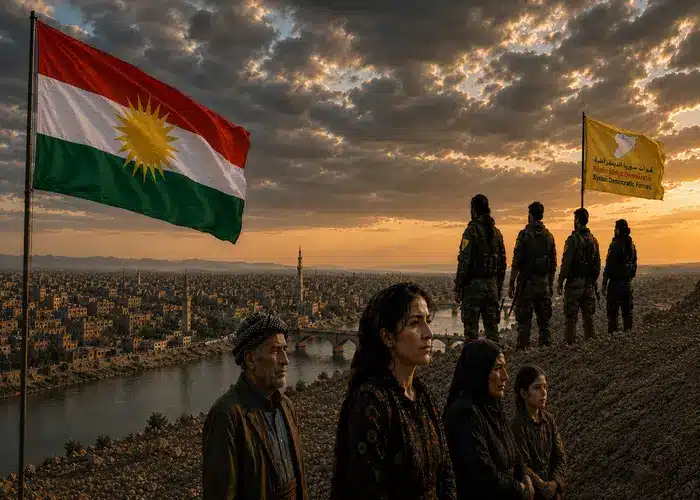
It was from these discussions that the idea began to develop, first conceptually and then in practical and logistical terms, of creating a new military framework that would later become known as the Syrian Democratic Forces. We worked on finding a consensual formula that could serve as a foundation, choosing an appropriate name and a flag that would not provoke political or ethnic sensitivities, and persuading the leaderships on both sides to secure the necessary approvals and agreements through meetings and discussions that continued for months.
The purpose of this new framework was not simply to rename the People’s Protection Units, the YPG, to create a larger version of them, or to replace them. Rather, it was intended as a political, military and diplomatic solution to a complex set of problems that were obstructing the expansion of international cooperation with the forces on the ground. There were considerable sensitivities surrounding the YPG because of the complexity of its political, ideological and organisational links with the Kurdistan Workers’ Party, the PKK, as well as the concerns of neighbouring states, particularly Turkey, and some Gulf countries. There was also the predominantly Kurdish character of the force and the reservations held by sections of the Syrian Arab opposition and some Arab communities towards it.
There were, in addition, difficulties in securing formal approval from the US Congress, the US government and other Western governments for broader levels of financial, military and logistical support. At the same time, the YPG had originally been established primarily to defend the Kurdish people and Kurdish areas of Rojava. It was therefore neither politically, socially nor militarily straightforward to redirect it on a permanent basis beyond its original areas and send it to fight across large Arab-majority territories far from the Kurdish regions.
This was why the work initially focused on establishing the Syrian Arab Coalition, following the training and preparation in Erbil of dozens of Arab and Kurdish leaders, tribal figures and activists. The Syrian Arab Coalition was later brought together with the Kurdish units, Syriac forces and other groups under a broader umbrella, eventually leading to the announcement of the Syrian Democratic Forces.
For this reason, and based on my own participation in the thinking that preceded the establishment of the SDF and in some of the practical and political stages of its formation, I can say today that the Syrian Democratic Forces were not created to become an enlarged or expanded version of the YPG. The intention was to build a broader Syrian framework bringing together Arabs, Kurds, Syriacs and others under a joint military umbrella for the fight against ISIS, while at the same time providing a political and diplomatic mechanism through which the international community could train, arm and provide logistical support to a multi-ethnic local force without such support remaining confined to a Kurdish force surrounded by complex political, regional and international sensitivities.
In the years that followed, the SDF demonstrated its ability to fulfil a substantial part of the role for which it had been created. It played a central part in confronting ISIS, defeating it militarily across large areas of north and eastern Syria and liberating extensive territories that had been under its control. The SDF also assumed responsibility for protecting a vast geographical area and, together with other civilian and military institutions and components, helped provide the security conditions that allowed the region to continue to be governed during one of the most difficult and complex periods of the Syrian war. It did so while facing multiple threats and conflicts, including ISIS, Turkey and Turkey-backed armed groups, as well as, at certain stages, Iranian-backed forces and militias and other competing actors in the region. All of this was achieved under extraordinarily difficult security, political and economic conditions.
The SDF therefore became far more than the framework originally created to facilitate cooperation with the International Coalition. Over the course of the war, it developed into one of the Coalition’s most important, enduring and reliable local partners in Syria, making enormous human sacrifices in the process that will remain an essential part of the history of the war against ISIS. Criticising what the SDF later became should therefore never mean denying the sacrifices of its fighters or diminishing the major military and political role it played during this period. Nor should the experience as a whole be reduced to its mistakes or to the manner in which it ultimately came to an end.
Over time, however, the SDF gradually moved in a direction that differed from many of the objectives that had accompanied its creation, and to a significant extent it reproduced the YPG model on a larger scale. This was reflected in what I regard as an excessive attachment, particularly at the level of leadership and official discourse, to non-Syrian ideological references, symbols and political thought, as well as in the continued influence of non-Syrian commanders in a number of sensitive positions. At the same time, the deployment of thousands of Kurdish fighters and commanders outside the Kurdish regions and into large Arab-majority areas drained a significant part of the human resources and capacities that Kurdish communities themselves needed. It also contributed to ethnic and local sensitivities, many of which might have been avoided had the original principle been preserved that local communities should participate directly in protecting their own areas and managing their own forces.
Similarly, attempts to transfer the ideological, political and organisational model that had developed in the Kurdish regions into Arab areas, and to impose or reproduce that model within communities whose historical, social and political circumstances differed considerably from those of Rojava, contributed to tensions that persisted for many years. Rather than remaining a flexible umbrella capable of accommodating different components and respecting the particularities of local communities and regions, the SDF at various stages came close to reproducing a single political and organisational model across areas that differed greatly from one another.
It is therefore important today to distinguish between the SDF as a military and political formation that emerged from a particular historical moment and the Kurdish question in Syria as a much older political and historical issue. At a specific moment, the SDF was a means of confronting ISIS, an umbrella bringing together different military and social components, and a diplomatic and political solution that facilitated international support, training, weapons and logistics for the forces operating on the ground.
The SDF, however, does not encompass the Kurdish question in its entirety. Nor does it alone represent Kurdish identity or embody the whole political history of the Kurds in Syria and their struggle for rights. Its significance was substantial, but it remained a military and political formation that emerged from a particular historical moment, rather than the embodiment of the Kurdish question itself. For that reason, the fate of the SDF and the fate of the Kurdish question should not be treated as one and the same.
The announcement today of the dissolution of the Syrian Democratic Forces, nearly eleven years after their establishment, in fact comes after several months in which the SDF had already been losing much of its position as an independent military force since the beginning of 2026, following the loss of a very large part of the territory it had controlled, the departure of most of its Arab fighters and allied forces, and the diminishing role that the International Coalition had assigned to it for years. The formal announcement therefore confirms a reality that had already been taking shape over the preceding months. Yet this does not mean that the Kurdish question has ended or been resolved, nor does it remove the need of the Kurds in Syria for protection, political and social organisation, clear constitutional rights, and national and international guarantees safeguarding their existence, rights, security and the future of their regions.
Likewise, the appointment of some SDF leaders to symbolic, administrative or military positions, or the reaching of political or personal settlements with them, does not in itself amount to a resolution of the Kurdish question. There is a fundamental difference between settling the status of a group of leaders and addressing a historical and political question concerning an entire people. Individual leaders may have their own interests, settlements and calculations, but these cannot substitute for the collective political and constitutional rights of the Kurds in Syria.
The Kurdish question in Syria did not begin with the SDF. It stretches back nearly a century and has passed through long periods marked by the denial of political, cultural and linguistic rights, policies of Arabisation, the exceptional census and resulting deprivation of citizenship, restrictions on political and cultural organisation, and attempts to deny Kurdish existence and identity. The Syrian Democratic Forces, by contrast, represent only around eleven years of this much longer history. They emerged from a particular historical period shaped by the Syrian war, the rise of ISIS, international intervention and the need to create a multi-ethnic local military framework with which the international community could engage and cooperate.
The end of this military formation therefore does not mean the end of the question that preceded it by many decades. A military organisation may be dissolved, alliances may change, forces and commanders may acquire new names, and some individuals may enter state institutions or obtain political and military positions or settlements. But the Kurdish question in Syria will not come to an end until the political, constitutional and historical causes that produced it are addressed.
The SDF was one chapter in both Syrian and Kurdish history, but it was also an important historical experience that emerged under particular political and military circumstances and went on to play a role far greater than the conditions that had initially brought it into existence. Yet it was never the Kurdish question itself. Its dissolution today should therefore not be presented by any party as the resolution of the Kurdish question in Syria. The Kurdish question did not begin with the creation of the SDF, and it will not end with its dissolution.
Disclaimer: The views expressed here represent those of the author and not necessarily those of the WKI