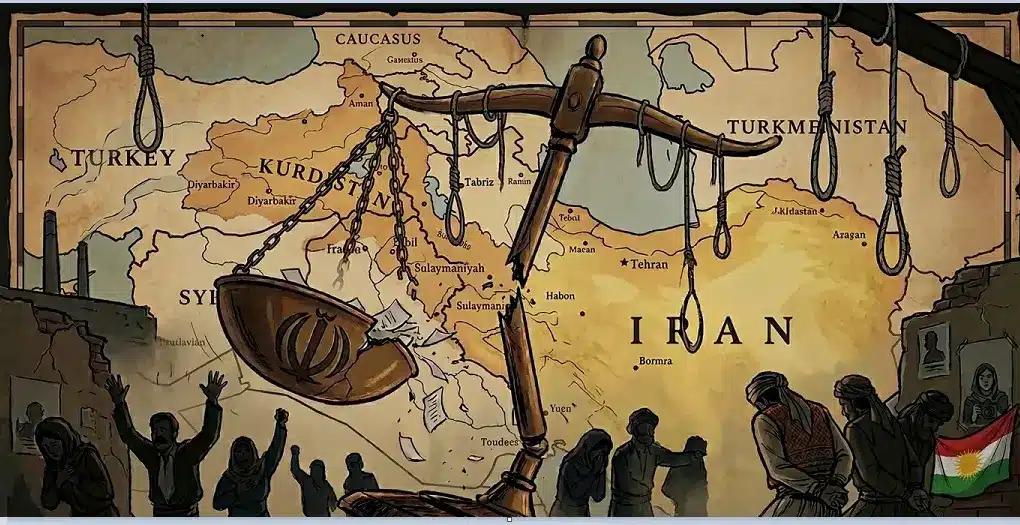
For Iran’s Kurdish population, the death penalty is not only a criminal-justice issue. It is part of a larger architecture of state control, political intimidation and national-security repression that has followed the Kurdish question since the establishment of the Islamic Republic. Kurdish activists, religious prisoners, protesters and ordinary prisoners are pulled into a judicial system where the state often controls the accusation, the interrogation, the confession, the court narrative and, finally, the rope.
That system is not new. The Islamic Republic’s record of political killing stretches back to its first decade in power, reaching one of its darkest moments in 1988, when Iranian authorities forcibly disappeared and extrajudicially executed thousands of imprisoned political dissidents in secret and buried many in unmarked mass graves, according to Amnesty International. The same language of state security, secrecy and ideological accusation that surrounded those killings continues to appear in today’s political cases. In 2025, Iran Human Rights and ECPM reported at least 1,639 executions, the highest recorded figure since 1989, showing that capital punishment remains central to the Islamic Republic’s method of rule.
The Kurdish experience inside that machinery is especially severe because political identity, ethnic identity and civil resistance are often treated as security threats. Hengaw Organization, which documents violations in Kurdistan and across Iran, reported that in the first quarter of 2026 alone, Iran executed at least 160 prisoners; only 12 of those executions were officially announced, and 17 were carried out secretly without notifying families or allowing final visits. Hengaw’s same report recorded 11 Kurdish prisoners among those executed from January through March.
In May, however, the number increased, with at least 80 executions recorded across Iran during the month, including 17 political prisoners. Among them were four Kurdish political prisoners: Naser Bakrzadeh, Mehrab Abdollahzadeh, Ramin Zaleh and Karim Maroufpour. In total, 17 Kurdish prisoners were executed in May across all categories. Added to the first quarter’s 11 Kurdish executions, April’s two Kurdish executions, and at least six Kurdish executions documented on June case pages through June 14, the conservative total reaches at least 36 Kurdish prisoners executed since Jan. 1, 2026.
These are not ordinary criminal cases, but cases and pretexts by the regime built around the vocabulary of national-security repression: “moharebeh,” meaning waging war against God; “baghi,” meaning armed rebellion; “efsad-e fel-arz,” meaning corruption on earth; alleged espionage for Israel; alleged membership in Kurdish opposition parties; and accusations of terrorism or separatism.
A glance at the victims shows that on June 1, Iranian authorities secretly executed Ashkan Maleki and Mehrdad Mohammadinia, two Kurdish political prisoners from Qorveh who had been arrested during the January 2026 protests. They were hanged at dawn in Ghezel Hesar Prison after being sentenced to death by Branch 15 of the Tehran Revolutionary Court on charges of moharebeh. The allegations included setting fire to a mosque and a seminary and damaging public property during the Jan. 9 protests. But the death sentences were based on forced confessions extracted under torture and security pressure. State media broadcast coerced confessions portraying them as agents of Israel and hostile governments, and both men were denied lawyers of their own choosing and other fair-trial guarantees.
Likewise, on May 21, Iran secretly executed Ramin Zaleh and Karim Maroufpour, two Kurdish political prisoners from Naqadeh. The official pretexts were familiar: membership in “separatist terrorist groups,” armed rebellion and attempted assassination. Zaleh endured 507 days of detention and legal limbo before being sentenced to death on “baghi through membership in the Democratic Party of Iranian Kurdistan.” His trial lasted only a few minutes, was conducted opaquely, and took place without access to a lawyer of his own choosing. Maroufpour, also accused of cooperation with the Democratic Party of Iranian Kurdistan, was reportedly subjected to prolonged enforced disappearance and sentenced in an unfair process.
Earlier in May, Iran executed Naser Bakrzadeh, a 26-year-old Kurdish political prisoner from Urmia, on charges of spying for Israel. His case moved through an expedited process, with his sentence upheld for a third time in only ten days. During detention at the Al-Mahdi facility, he was subjected to severe torture to extract forced confessions. The execution was carried out in secret at Urmia Central Prison.
The following day, Mehrab Abdollahzadeh, a 27-year-old Kurdish political prisoner from Urmia detained during the Woman, Life, Freedom movement, was secretly executed at Urmia Central Prison. He had been sentenced on charges including baghi and efsad-e fel-arz in connection with the killing of a government-affiliated individual during 2022 protests. Abdollahzadeh was denied the charges and said his confessions had been extracted under severe torture. His retrial request was rejected, and the execution proceeded despite a renewed appeal and without due legal process.
A Kurdish citizen may be labeled a separatist, a terrorist, an Israeli spy, a member of a banned Kurdish party, an enemy of God or a corruptor on earth. Once that label is attached, the machinery moves quickly: arrest, isolation, torture, confession, revolutionary court, secret transfer, denial of final visit and execution.
There are many more Kurds who await execution on the basis of forced confessions extracted under torture and politically motivated security charges, without credible supporting evidence. However, the regime’s death machine will not be stopped, especially against Kurds.
This is why many Iranian Kurds speak not only of discrimination, but of a system designed to deny them political existence. The injustice goes beyond executions. It includes arbitrary arrests, pressure on families, suppression of the Kurdish language and civic organizing, militarization of Kurdish areas, denial of due process, and the criminalization of Kurdish political identity. But executions sit at the center of all.
For Iranian Kurds, regime change is therefore not an abstract slogan. It is a demand born from lived experience: decades of executions, prison sentences, security accusations, coerced confessions and a judiciary that treats Kurdish political life as a threat to be crushed. The execution cases of many Kurds like Maleki, Mohammadinia, Bakrzadeh, Abdollahzadeh, Zaleh, Maroufpour, Karavanchi and Sheikhi show a pattern too consistent to dismiss as individual miscarriages of justice. They expose a state policy in which the Kurdish question is answered not with rights, federalism, cultural recognition or democratic inclusion, but with gallows, fear and silence.
The Kurdish demand for regime change comes from that reality. It comes from a people who have watched their activists called enemies, their prisoners tortured into confession, their families denied farewells and their dead used as warnings. In the Islamic Republic’s execution culture, the Kurdish population has seen what the regime offers them. It is not justice. It is domination.